
How to Play Hot Ross — Step-by-Step Guide
This guide covers everything you need to start playing Hot Ross by Hacksaw Gaming: how the mechanic works, how to navigate the three free spins tiers, how to use Feature Buy, and how to structure a session so that you experience the game’s mechanic without exhausting your bankroll in the first 20 spins. We start with the full Hot Ross overview if you want the mechanic context before the step-by-step.
Before You Start
Hot Ross is a high-volatility slot with a 15,000x maximum win and a 96.32% RTP under its default configuration. Before placing a real-money bet, there are three decisions worth making explicitly rather than leaving to the moment:
Decide your session budget and stick to it. This is not a recommendation — it is the most important practical decision you will make before opening Hot Ross. Decide the maximum amount you are willing to lose in this session. Write it down. That figure is your absolute ceiling, not a figure you expect to reach. High volatility means that losing C$30, C$50, or more in a session without triggering the bonus is a plausible outcome, not a malfunction. At C$1 per spin over 100 spins, you will wager C$100. The expected loss at 96.32% RTP is approximately C$3.68. In practice, the actual loss could be anything from C$100 (losing the entire stake) to a profit — both are plausible. Budget for a realistic bad-case outcome, not the expected average.
Try the demo version before playing with real money. Hot Ross has a demo mode available at several review sites and operators. Play 50–100 demo spins before switching to a real-money session. Your goal is not to “learn the strategy” — there is no strategy that changes the expected value. The goal is to see the Ro$$ expanding wild mechanic, observe what a Hot Ro$$ chain expansion looks like, and understand the pacing of a high-volatility session so that a long dry run in real money does not feel alarming. The mechanic is more legible after you have seen it in action with no financial pressure.
Set realistic expectations about what Hot Ross is. Hot Ross is entertainment that happens to have a financial cost — the 3.68% house edge on every spin under the default RTP. Sessions that end in profit represent a favourable short-term deviation from the expected return. They are possible, frequent enough to be interesting, and not the mathematical expectation over time. Approaching the game as recreation with a fixed budget produces a very different psychological experience than approaching it as income. See our responsible gambling page for further context on managing that distinction.
Understanding Hot Ross’s Mechanic
Hot Ross uses a 5x5 reel grid with 19 paylines, paying left to right from the leftmost reel. A standard paytable covers ten symbols: five low-pay card ranks (10, J, Q, K, A), five high-pay thematic symbols (Banana, Fish Bones, Spray Can, Dice, 8-ball), a Wild (bomb with a pink W), a Scatter (FS symbol in black and blue), and two special wild variants — Ro$$ (standard cat head) and Hot Ro$$ (cat head with a pink and yellow striped background).
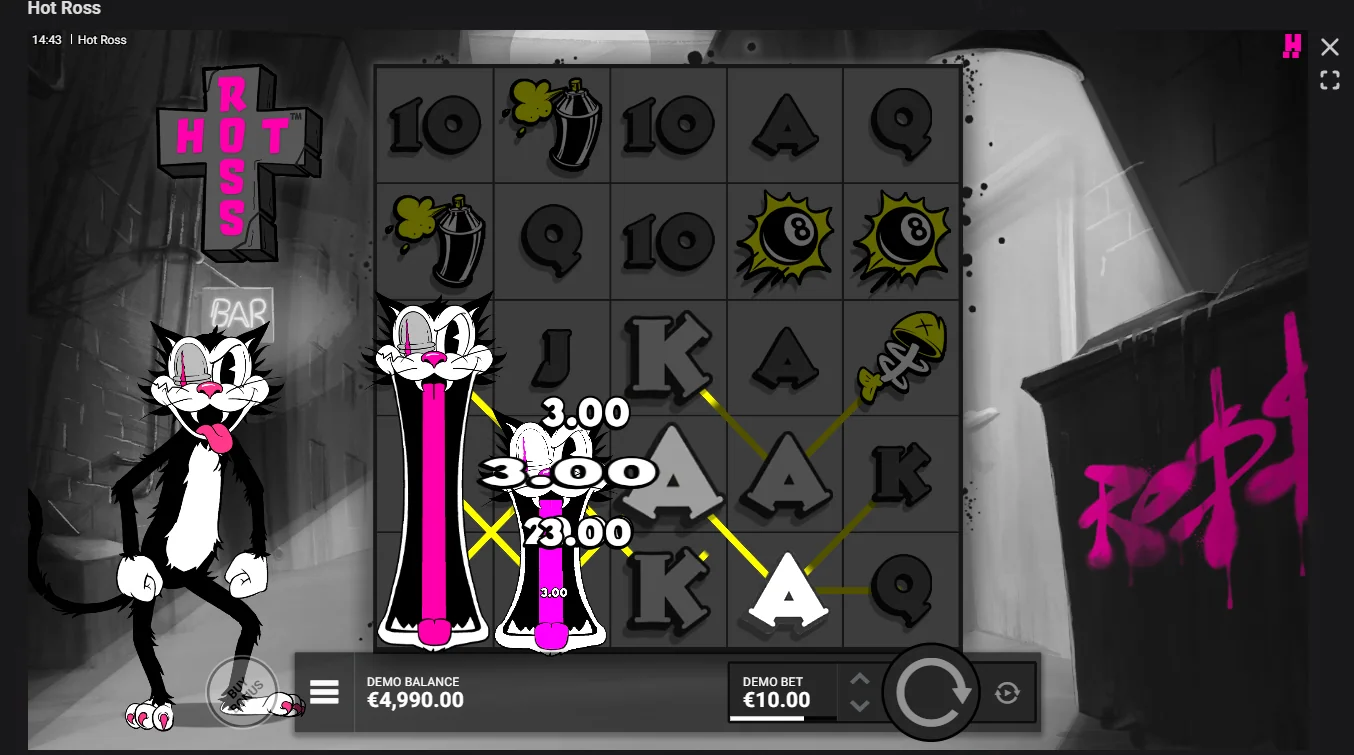
The mechanic that defines Hot Ross is the Ro$$ expanding wild system. When a standard Ro$$ symbol lands in a position that would complete or improve a winning combination, it expands downward from its landing row, covering all cells below it on that reel. When a Hot Ro$$ symbol lands anywhere on a reel, it immediately jumps to the top position of that reel and expands to cover all five rows — functioning as a full reel-covering wild. The chain expansion then triggers: any standard Ro$$ symbols on directly adjacent reels (left and right) also jump to the top of their respective reels and expand to cover all five rows. This chain reaction can simultaneously convert multiple reels to full wild coverage in a single spin evaluation.
The multiplier system operates on top of this expansion mechanic. When a Ro$$ or Hot Ro$$ wild expands and its expansion path passes through the position of a standard Wild symbol, a multiplier is collected. Individual multiplier values are discrete: x2, x10, x15, x20, x25, x50, x100, and x200. Multiple wilds in a single expansion path add their values together — an expansion through a x25 wild and a x100 wild produces a x125 multiplier on that spin’s win. A chain expansion that passes through wilds on multiple reels simultaneously can produce substantial multiplier totals.
| Element | How it behaves | Player action |
|---|---|---|
| Standard Ro$$ (cat head) | Expands downward if part of a winning combination | Watch for landing position and which symbols it covers |
| Hot Ro$$ (pink/yellow) | Jumps to reel top, covers all 5 rows | Triggers chain expansion — best single-spin event in base game |
| Chain expansion | Adjacent Ro$$ wilds triggered by Hot Ro$$ | Multiple reels can convert to wild simultaneously |
| Wild (bomb, W) | Multiplier source when expanded wild crosses it | Position matters — wilds in expansion path multiply the win |
| Scatter (FS) | 3/4/5 trigger bonus tiers | Collect 3+ simultaneously; does not accumulate across spins |
| Free spins retrigger | 2 additional scatters = +2 spins; 3 = +4 spins | Extends bonus but requires scatters to land again during free spins |
Step-by-Step
The following steps cover a complete Hot Ross session from account setup to session close.
-
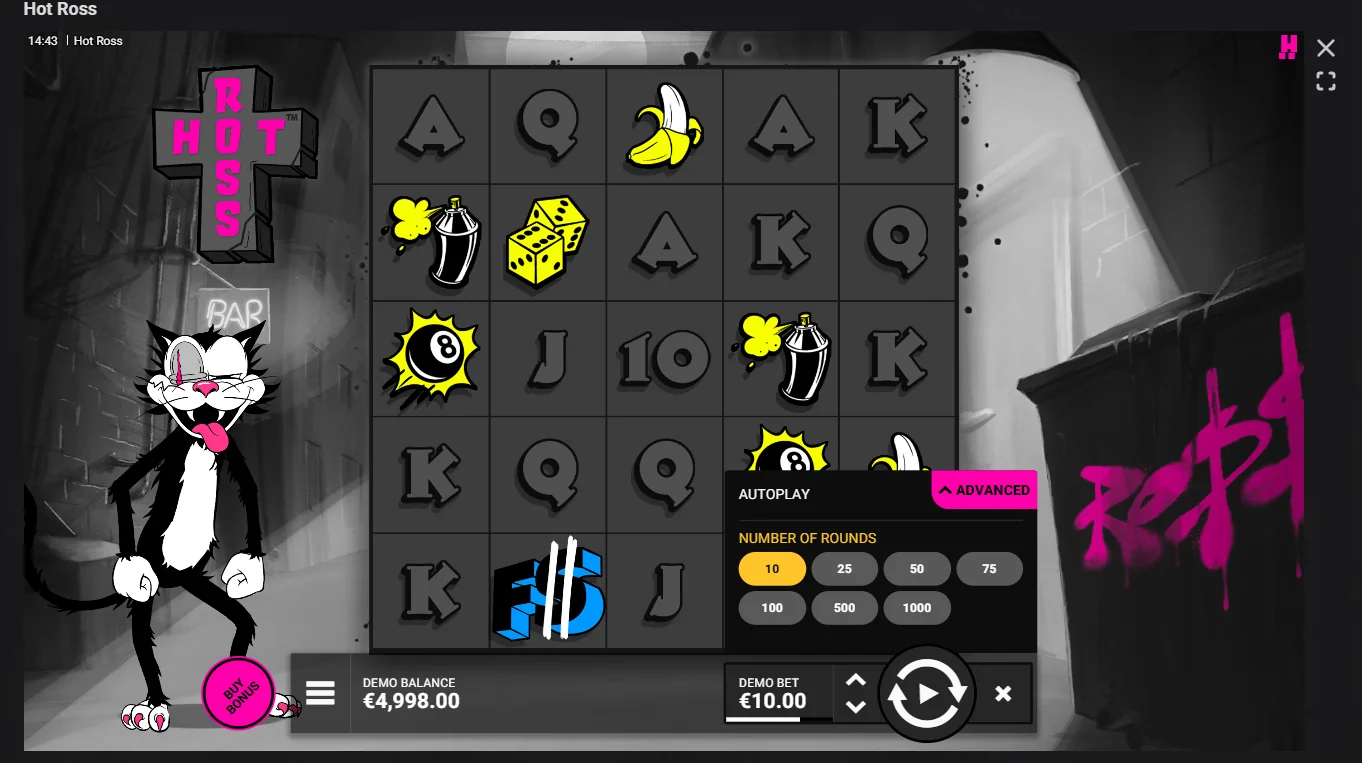
Set your stake before your first spin. Use the coin or stake controls to select your bet per spin. Hot Ross accepts C$0.10 to C$50 per spin. Your stake affects the absolute value of every win and loss — it does not affect the probability of any outcome. Set the stake that corresponds to 1–2% of your session budget, not the largest stake the operator allows.
-
Use demo mode for your first 50 spins. Access demo play through the operator’s “Play for Free” option or through an aggregator review site. In demo, observe how frequently standard Ro$$ symbols land, how often Hot Ro$$ appears, and what a chain expansion looks like when multiple reels convert simultaneously. Note the length of sequences without significant wins — this is the high volatility profile you are budgeting for in real money.
-
Place your first real-money spin. Click Spin or activate Auto-spin with your configured stop conditions. Watch the reels for Ro$$ (standard cat head) and Hot Ro$$ (pink/yellow) symbols — these are your primary mechanic triggers. A standard Ro$$ expands downward. A Hot Ro$$ covers the whole reel and triggers adjacent chain expansion.
-
Track Wild positions during expansion. When a Ro$$ or Hot Ro$$ wild expands, watch for Wild (bomb) symbols in the reel columns being covered. Each Wild in the expansion path adds its multiplier value to the win. A spin with a Hot Ro$$ chain expansion crossing two or three Wild symbols is the closest Hot Ross gets to its maximum win territory in the base game.
-
Identify scatter symbols and count them. The FS scatter is a distinct black-and-blue symbol. Three landing simultaneously triggers the Cat Calls bonus (10 free spins). Four triggers Nine Lives (10 spins with activated-reel mechanic). Five triggers Bigg Boss Ross (10 spins with guaranteed Hot Ro$$ and Wild on every spin). You cannot collect scatters across spins — all three (or four, or five) must land in the same spin evaluation.
-
Navigate the free spins tier you have entered. In Cat Calls: play the 10 spins with elevated Ro$$/Hot Ro$$ frequency and collect retriggers if 2 or 3 scatters land. In Nine Lives: after a Ro$$ or Hot Ro$$ first lands on a reel, that reel is “activated” and guarantees a Ro$$ or Hot Ro$$ on every subsequent spin in the bonus. In Bigg Boss Ross: every spin includes a minimum of 2 Hot Ro$$ symbols and 1 standard Wild — the conditions most likely to produce multiplier stacking and the game’s higher win values.
-
Close the session at your pre-set budget limit. When your session loss reaches the figure you set before starting, close the game. Do not make an additional deposit to extend the session. This is the most important step, and the one most likely to be skipped when the game has been running unfavourably. Hot Ross’s high volatility means that a large win on the next spin is always theoretically possible — and always equally unlikely as it was on any other spin. The budget limit is not a target; it is a hard stop.
Reading the Screen
| Indicator | What it shows | What to do | Common misreading |
|---|---|---|---|
| Balance display | Current account balance | Track against your session budget ceiling | Confusing total balance with session budget |
| Bet per spin | Your configured stake | Verify before each session | Forgetting to adjust after a previous session |
| Win display (after spin) | Win amount for the evaluated spin | Note whether a Ro$$ or Wild contributed | Attributing large wins to “hot streaks” |
| Multiplier indicator | Multiplier value collected when Wild crossed | Cumulative value shown per spin | Treating multiplier display as persistent or building |
| History panel | Last 10–20 spin outcomes | Use only for game log context | Using past scatter gaps to predict future scatters |
| FS counter (during bonus) | Remaining free spins | Track retrigger potential | Losing count of remaining spins |
| RTP info button | Displayed RTP version at this operator | Check this before first spin | Assuming all operators run 96.32% |
| Auto-spin settings | Configured stop conditions | Set loss limit and single-win limit before activating | Running auto-spin without stop conditions |
Common Approaches to Hot Ross {#strategies}
There are several ways players commonly structure their Hot Ross sessions. None of them changes the expected value of the game — that is set by the RTP and the house edge. What they change is the shape of the session: how long it lasts, how large individual swings are, and what the probability of reaching the bonus feature is before the session budget is exhausted.
- Flat stake / fixed bet — Playing the same stake per spin throughout the session. Simple to execute, consistent variance per spin. At C$0.50 per spin with a C$50 budget, you have 100 spins before reaching your budget ceiling — enough to experience the game’s normal variance range.
- Percentage of remaining balance — Adjusting the stake to a fixed percentage of your current balance after each spin. This mathematically extends the session indefinitely (you can never reach zero) but compresses stakes as the balance falls, which can produce sessions that feel interminable at small stakes after a bad run.
- Session stop-win — Setting a win target that, if reached, ends the session. For example, stopping if you double the session budget. This locks in profit from favourable sessions; it does not improve the expected value of subsequent sessions.
- Auto-spin with loss limit — Using the auto-spin feature’s built-in loss limit to enforce the session budget ceiling automatically. This removes the need for manual discipline at the end of a losing run — the operator’s system stops the session when the limit is reached.
Why Strategies Don’t Beat RTP {#why-strategies-dont-beat-rtp}
Hot Ross returns approximately C$96.32 per C$100 wagered under its default RTP configuration. That figure applies regardless of how you vary your bet size, when you spin, how long you wait between spins, or what the history panel shows. The RNG that determines each spin’s outcome operates independently of all prior spin outcomes and independently of any betting pattern the player uses.
The gambler’s fallacy — the belief that past outcomes affect future probabilities — is intuitive because humans are pattern-recognition systems applied to a process that has no pattern to recognise. A 40-spin gap since the last bonus trigger does not mean the next spin is more likely to trigger the bonus. The scatter probability on spin 41 is identical to what it was on spin 1. Betting strategies that respond to past outcomes — Martingale, reverse Martingale, D’Alembert — all assume that past outcomes carry information about future outcomes. They do not. In practice, the only effect of these strategies in a high-volatility game like Hot Ross is changing the speed of bankroll depletion in bad runs, and increasing the absolute size of losses when a losing sequence eventually ends.
What bankroll management genuinely does: it determines how many spins you can access with your budget, which determines your probability of encountering the bonus before your budget is exhausted. At a C$50 budget and C$1 per spin, you have 50 spins. At C$0.50 per spin, you have 100 spins. The per-spin expected loss is the same; the session length is longer, and the probability of hitting a bonus trigger in that span is correspondingly higher. See our responsible gambling page for context on managing the boundary between recreational use of these tools and chasing-loss behaviour.
After a Session
After a Hot Ross session — win or loss — the same behavioural patterns apply.
After a winning session: Withdraw the profit promptly rather than rolling it back into additional play. The expected value of any additional session is negative — the win does not change the game’s house edge for future sessions. If you want to continue playing, set a new session budget from funds you are comfortable losing, not from the previous session’s profit. Treating winnings as “house money” that can be reinvested without consequence is a common driver of sessions that begin profitably and end at a large loss.
After a losing session: Do not open another deposit to “get back to even.” The probability of a profit on the next spin is identical to what it was before the losing run. Hot Ross has a 3.68% house edge per spin — a second C$50 session has the same expected cost as the first. If you find yourself making a second or third same-day deposit after losing, that is a behavioural pattern worth noting. See the responsible gambling page for self-assessment tools and Canadian support resources.
Log the session result. Keeping a simple record — date, session budget, outcome — builds an accurate picture of your long-term experience with Hot Ross over time. Players who do not keep records consistently underestimate their total wagering and overestimate their wins, because large wins are memorable and routine losses are not. Accurate records are the baseline for honest self-assessment.
RNG reminder: Each spin’s outcome is generated by a certified random number generator. The outcomes of previous spins have no effect on the probability of future spin outcomes. A long losing run does not predict a win; a long winning run does not predict a loss. The next spin is always a fresh, independent event.
Pre-Session Checklist
Before opening Hot Ross with real money, confirm each of the following:
- ✓ Session budget set and recorded — The maximum you will lose in this session, decided before the session begins.
- ✓ Stake sized at 1–2% of session budget — Ensures enough spins to experience the mechanic before the budget ceiling.
- ✓ Demo mode tested — At least 30–50 demo spins completed before switching to real money.
- ✓ Operator RTP version checked — Opened the game’s info panel or asked support which RTP version of Hot Ross is in use.
- ✓ Auto-spin stop conditions configured — Loss limit and optionally a single-win limit set before activating auto-spin.
- ✓ Session time limit noted — Decide maximum session duration, not just maximum spend; Hot Ross sessions can run longer than intended.
- ✓ Not playing to recover a previous session’s losses — If the primary motivation for this session is recovering a prior loss, stop and review the responsible gambling guidance first.